Monday, November 17, 2014

The Most Popular Fashion Icons

Last month, TIME Magazine compiled a list of the top 100 fashion icons in five categories: Designers & Brands, Models, Muses, Photographers, and Editors & Stylists.

Here is a preview of the Top 10 from the Designer & Brand, Model, and Muse category:

Designers & Brands


Models

5. Iman
10. Twiggy

Muses


To view the full list for each category, click here

Wednesday, November 12, 2014

The 100-year history of the modern bra

Did you know that on November 3rd of this year, the modern bra turned 100 years old?

Me either!

The first patent for the modern bra was issued in 1914. It was created by Mary Phelps Jacob when she was just 19 years old.

It consisted of two handkerchiefs sewn together with straps that tied around your neck. The look was similar to a halter top bikini. It wasn't as conforming, but it was much more comfortable than the metal corsets women had previously worn.

Jacobs, who later changed her name to Carasse Crosby, sold the patent to Warner Brother's Corset Company in Bridgeport, CT for $21,000.


Sources: TIME Magazine


Below is a timeline for the complete history of the bra. Click HERE for a larger view:


Tuesday, November 4, 2014

#smallbusiness Saturday - November 29, 2014


A few weeks ago, the studio shared that we are officially part of #smallbusiness Saturday on November 29, 2014.

What does that mean for you?

All customers with a registered American Express card (call the number on the back of your card BEFORE November 29th to register) can get up to $30 back on any purchases made at a small business on that day. This includes purchases made at the studio!

All you have to do is use your American Express card to make a single, in-store transaction of $10 or more, and you will receive a $10 credit on your next month's statement.

Visit Shopsmall.com/OfferTerms for more information and to register your Amex card before November 29th. Or call the phone number on the back of your card. If your card is not registered before this date, you will not receive credit.

We look forward to seeing you on November 29th!


Tuesday, October 28, 2014

A History of Women's Clothing Sizes


Our workroom supervisor, Brittany, 
e-mailed me a great article today from TIME about women's clothing sizes in history.
Here are some interesting facts I gathered!:

- True sizing standards didn't develop until the 1940's
- Initial sizing was based on a person's age, so a child of the age of 8 would wear a size 8. (How did that work??)
- U.S. manufacturers wanted a change in the sizing system when it was estimated that they were losing up to $10 million a year
- The National Bureau of Standards re-analyzed the sizes of women's clothing by basing the measurements of women who had served in the Air Force, this created a sizing scale of 8 to 38 with height indications of tall, regular, or short.
- There were no size "0", let alone triple zero as we have today.
- The original 1940's sizing standards were withdrawn in 1983 because of vanity sizing, thus numbers started to get smaller.
- In 1958, a size 8 corresponded with a bust of 31 inches, a waist of 23.5 inches and a hip girth of 32.5 inches. In ASTM’s 2008 standards, a size 8 had increased by five to six inches in each of those three measurements, becoming the rough equivalent of a size 14 or 16 in 1958. We can see size inflation happening over shorter time spans as well; a size 2 in the 2011 ASTM standard falls between a 1995 standard size 4 and 6. (Slate)
- In the 40's a model was a size 16, in the 60's a 12 - which was the size of Marilyn Monroe.

To read the full article, click HERE.

Friday, October 24, 2014

Friday Flashback: Bridal Gown

Whenever the studio re-designs a garment, (and gets permission to post the photos, of course :)) we will feature it on our "Flashback Friday" entry with the original garment and the re-designed one so you can see what's going on in the studio!

Today's first "flashback" features a client from a couple weeks ago who used her mother's wedding dress for her wedding day. She and her mother graciously gave us permission to show the beautiful dress' "before" and "after" to you!


Beautiful!

Monday, October 20, 2014

The top 20 Halloween Costumes of 2014


Halloween is around the corner and we've been getting lots of client requests for custom made costumes. So I got to thinking, what are the most popular costumes of 2014?

According to Yahoo, this year's top 20 most-searched Halloween costumes are:

1. Ninja Turtle Costumes
2. Pirates 
3. Star Wars Costumes
4. Poison Ivy 
5. Superhero Costumes
6. Catwoman 
7. Monster High 
8. Olaf Costumes
9. Frozen Elsa
10. Tinkerbell
11. Pocahontas
12. Minnie Mouse
13. Alice in Wonderland
14. Little Red Riding Hood
15. Great Gatsby
16. Minion Costume
17. Maleficent Costume
18. Wonder Woman
19. Frozen Anna
20. Katniss Everdeen Costume

To read about other costumes that made the list, click here. They also compiled a list of the most popular kids costumes, costumes based on recent movie characters, and classic ones too!

Monday, October 13, 2014

10 Interesting Facts About Sewing


1. Archaeologists believe that people used to sew together fur, hide, skin, and bark for clothing as far back as 25,000 years ago.

2. Early sewing thread consisted of thin strips of animal hide that were used to stitch together larger pieces of hide and fur.


3. The sewing machine was invented in 1790 by Thomas Saint.

4. The Singer sewing machine was patented by Isaac Merritt Singer in 1851.

5. Singer's patent was the most dominant firm in the industry compared to other competitors.


6. Early sewing needles were made of bone and ivory.

7. "The whole nine yards," a common phrase, came from the fabric that was needed to make the fanciest coat for a man of fashion.


8. In the 20th century, more than 4,000 different kinds of sewing machines were made.


9. Women began forming sewing society's in the 1860's where they would gather together and make quilts to sell at church bazaars.

10. The 1950's are regarded as sewing's "golden age" because of a strong focus on fashion sewing, designer patterns, and copying Hollywood looks.


Sources: sewingmantra.com, sewmuchmore,biz, historytoday.com, sewnplace.com, sewretrothebook.com, encyclopedia.com

Friday, October 10, 2014

Hello Again!

Apologies for not writing in a few months! We've been keeping very busy! And now that it's almost Halloween, we're going to be even MORE busy which we love!

We have a ton of costumes and clothing to choose from at the studio. From medieval to superheroes, from sports stars to famous icons, we have all that and more!

Here's just ONE of our new costumes channeling Marilyn Monroe in her iconic scene in The Seven Year Itch.

Still not sure who you want to be this year? That's okay! We will be sharing more costume photos over Facebook for the next three weeks before Halloween. 

If there is something specific you would like us to create or alter, send us a message at info@sewingdesignstudio.com or call us! We also have rentals as well so even if you just need one last piece to complete your costume, we probably have it!

Tuesday, May 6, 2014

June 6th Silk Scarf Paining Party -A Look in to the HIstory of The Silk Road

Marilyn Johnson Sewing Design Studio is having a Silk Scarf painting party June 6th.  Examining the history of the The Silk road is an interesting way to see how different cultures use the silk fiber.   Rhea L. Combs' article Combs, Fashion at the Silk Road Festival states the Silk Road stretched from China east to Korea and Japan also to India and then South to Turkey and Italy.(Combs, 2008)  The Silk Road was the bridge between western culture and eastern Culture.  In China silk was used to clothe the emperor, fishing nets, paper, and musical strings.(Kurin, 2014) www.collegefashion.net  discussed the fashion history of scarves and how they were used. One example of historical uses, in ancient china warriors used their scarves to identify their military ranking. (Rachel, 2011) Women did not start using scarves as fashion accessories in Europe until 1800s.  The fashion trend for summer of 2014 is Hand painted silk scarves in bright colors. Based on the www.silkscarvesblog.com silk scarves add elegance, grace, and color to the wardrobe. What makes our craft party experience unique is the people who participate design their own silk scarf and leave with one of a kind fashion accessory .  

Work Cited:

Combs, Rhea L. Catwalking through Culture: Notes from 2002 Smithsonian Silk Road Festival, 2008 Journal of American Folklore 121(479:112-123

Kurin, Richard , The Silk Road Connecting People and Cultures. 2014 Smithsonian Institution. www.festivals.si.edu


Rachel, History of the Trend:Fashion Scarves Bulter University 2011                                                       www.collegefashion.net

Wednesday, November 27, 2013

Catching Fire and Fashion

***Note: If you have not read the book or seen the movie, there are some spoilers below.***

Yesterday I discussed in depth why I loved the fashion in the book trilogy The Hunger Games (fashion as rebellion, costumes drive the plot, costume designer main character), and why I was therefore disappointed with the film version of the first book (lame costumes).  Today I discuss the second film, Catching Fire, which came out last Thursday, and my love of the movie.  I will also discuss the concurrent marketing campaign that took what should have been a mirror to ourselves and put it in a department store dressing room.

I have nothing but praise for Trish Summerville's work on Catching Fire. The District citizens were impoverished looking, wearing natural fibers and animal skins, but the silhouettes were not necessarily of "our" time in fashion.  These warmer earth tones and soft fibers contrasted nicely with the stark white manufactured fabrics on the Peacekeepers, terrifying guards sent in by the Capitol to control the general populace.

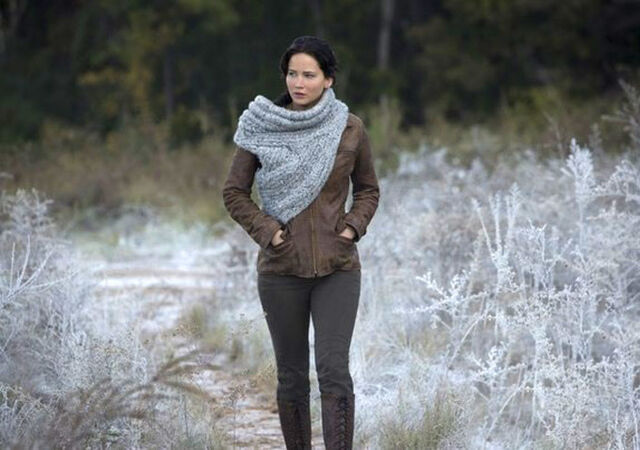


And the Capitol citizens were brilliant.  Huge unwieldy costumes, swaths of bright colors and rich fabrics galore, and the most impractical footwear.  Historically, unwieldy fashion has always been reserved for those who can "afford" to mince around on scrunched toes and in giant contraptions designed to work against the body to create an artistic and eye-catching shape, rather than to perform the everyday motions of the poor.  Capital fashion, like the high-heeled French bourgeoisie, corseted Victorian English, bound-feet Chinese upper class, and our modern surgery-inspired wealthy fashion, is designed to scream "I don't do manual labor."


Effie Trinket, Katniss's Capitol liaison and resident Miss Manners, wears elaborate uncomfortable ensembles that reflect each season, which was a brilliant way to incorporate the throwaway nature of Capitol fashion trends and do a practical bit of storytelling, showing the long, arduous process of the first year in spotlight after winning the Hunger Games.  In both films, the uniforms for the actual Games were portrayed very accurately: simple, practical outfits with manufactured fibers built to withstand extreme heat or cold, but with no creature comforts.  This is, after all, a battle to the death.


The portrayal of Cinna's creations in this film are perfection: once again dressing Katniss and Peeta up to look terrifying and angry that they are being forced back into the Games.  And then there is The Dress.  The wedding gown President Snow forces Katniss to wear in her interview to prove her submissiveness and complicity with the Capital is designed by the ever-crafty Cinna, and has a surprise for the viewing audience.  Once she starts spinning, the gorgeous but awkwardly heavy bejeweled wedding gown befitting a princess literally catches fire, turning black and unfolding into wings.  For a brief moment, she is the mockingjay, her token pin and a burgeoning symbol of the resistance.  This moment is the moment that inexorably links her to the resistance, and ensures her leadership in the full-scale rebellion, and the gown shoulders the responsibility stunningly.


It is not difficult, however, to ascertain that the wealthy, insensitive, over-indulgent Capitol citizens, who enjoy their opulent lifestyles on the backs of the impoverished District citizens, are an allegory for the United States and its first-world brethren.  We root for Katniss because she is the main character, and the underdog, and just totally badass, but not because we can relate to her.  Each of the twelve Districts in the book is dedicated to producing one vital aspect of the Capitol citizenry's cushy lifestyle: coal, lumber, textiles, weaponry, luxury items, etc.  The Capitol produces very little and consumes the majority of what is produced in the Districts; for example, in District 12 nearly every citizen is dedicated to work in the coal mines, and yet lights flicker and people freeze to death in winter.  What one would hope should come out of the popularity of this series is a sensitivity and sympathy for those in less fortunate circumstances, particularly when we directly benefit from their labor, as in the fashion industry.

We still live in a world in which hundreds of people can die in a factory fire making luxury items they will never own themselves.  What I would have loved to see in the marketing for these films is a recognition of this fact through PSAs, public discussion, or publishing supplemental material.  Instead, a fashion marketing campaign was run that not only accepted the fact that we are Capitol citizens but embraced it full on, encouraging us to buy "Capitol Couture," to emulate the fictional consumers by becoming them ourselves. Instead of elevating a relevant and sensitive subject to do good in the world, we are left with this lame attempt at "we're not the bad guys, really!" marketing.  As a story-telling device, the costumes in Catching Fire were spot on: perfectly framing the opulence of the Capitol vs. the forced poverty of the Districts.  But this kind of high fashion escapism is exactly what is wrong with the people we consider ourselves intellectually above in the films. This marketing campaign could have learned from our past and done something interesting and inspired, but instead chose to perpetuate established norms.